Wednesday, 23 May 2012

Gone Veggie


Vegetarian friends have come to stay for the week, which pretty much makes me a vegetarian. For the week. They’ve picked a good time to come. We’re into late spring and there’s plenty of nice stuff about. The asparagus has already peaked, but there’s been a trickle of broad beans for a fortnight now, and the peas are about to explode. Young and green and fresh and sweet is the thing. Some crisp radishes, kohlrabi, baby fennel – in a raw salad: sliced fine, except for the peppery radishes which are more juicy whole or in half, dressed with lemon juice and olive oil and thyme flowers. People who are morally opposed to bread won’t enjoy this as much as me.

Last night we had a risotto with the broad beans and peas from the market. The veggie stock was given a bit more oomph from their pods and the result was lighter and fresher than it would have been had I used the ham broth that’s sulking in the fridge. Some parmesan or brebis might have been good, but we had neither. Butter added richness on its own instead. It’s more critical than cheese if you ask me.

I had been hoping to share a real favourite of mine: Moroccan eggs from the Casa Moro book – fried with tomatoes, garlic, cumin and corriander. They’re really a top treat which turns a sunny-side-up into a proper meal. I only didn’t because Rory beat me to it. His eggs were Tunisian, and almost identical to what I’d had in mind. Bloody know-it-all veggies... It was delicious.

Vegetarianism is a strange concept to the French. Bad animal husbandry seems more of a concern with regard to health risks that might be passed on to consumers than the welfare of the animals themselves. They certainly have some wonderful vegetable dishes, but they tend to cry out for a pork chop, a magret or a nice bit of cod to make sense of them... I have to admit this is my own default setting and it’s good to be forced to think differently. Turning veggie doesn’t tempt me either, but there is something very satisfying about a meal that doesn’t happen to involve meat.

Plenty of my prefered Indian and Arab dishes are meat-free; pulses and spices and tomatoes and meaty veg. Even from the carnivore’s perspective, greengrocer dishes have to be the backbone of cooking and eating well. They offer contrast to meat – either on the same plate, or on their own, providing relief from other days where the emphasis is on meat or fish. Rick Stein commented how the glorious variety of simple vegetable dishes was what he had most enjoyed while filming his tour of the Mediterranean. That boy knows his stuff. This time of year is the start of the glut of fresh young vegetables which so enhances this kind of eating. Down here we are deprived of our Liverpool allotment, but are fortunate to have a thriving local farmer’s market which is at least the next best thing – especially when you bear in mind our unglorious battle with the slugs...

I’ve raved about Manjula’s kitchen before. She provided me with the instructions to make Moong Dhal Dosa - pankakes made from ground mung beans stuffed with spicy potatoes. A winner. Particularly good with the crunchy salad described above.

Next, a happy memory from West African travels: Red-Red, a spicy pauper’s bean stew with plantains. It’s all about the garish red palm oil which provides a very distinctive taste as well as colour. Having been far too timid to ask for the recipe from one of the Ghanaian ladies who would sell it on street stalls and spot cafes, I eventually found it courtesy of a fellow blogger.I changed the recipe a bit so include it below. And of course I would never have dreamed of including the optional shrimp paste for our vegetarian guests!


Broad Bean and Pea Risotto (to serve 4) I forgot to take a photo. Soz.

This recipe is for a late-spring risotto. It is very easy to change it to suit whatever ingredients you have to hand. The most important element is a tasty stock.


A small onion or 2 – 3 shallots, finely diced
2 or 3 cloves of garlic, chopped
A celery stick, finely chopped
4 fat handfuls of Arborio or Carnaroli rice
A glass of white wine (optional)
Vegetable stock (from a cube is fine) or some ham or chicken stock (ideally not from a cube)
A couple of good handfuls each of broad beans and peas in their pods
Lardons (bacon bits – optional)
Olive oil
Butter
S&P
A generous amount of herbs - parsley, mint, chives, celery leaves, 4 or 5 lovage leaves (use some or all – whatever you can get)
Parmesan or some hard sheep’s cheese (such as croglin, from Cumbria, or a Pyrenean Brebis – optional)


Pod the peas and broad beans. Reserve the pods as they will give a flavour boost to your stock.
With a good glug of oil and a blob of butter, gently sweat onions, garlic and celery in a heavy based pan that is broad enough to easily take all the ingredients in a fairly shallow layer. Add bacon now, if you like. (If it appeals, you can fry a little bacon separately and keep to use as a crispy garnish at the end. Whatever floats your boat.)

Heat up the stock in a separate pan. If the broad beans are large blanch them in the stock for a few minutes, fish them out and refresh in cold water. Add the pea and bean pods to the stock.
After a little while, turn up the heat a notch and add the rice. Fry briefly, coating the rice in the oil. Add a little salt.

Pour in a glug or two of wine. Not too much. Feel free to start drinking. It’s not a big deal if you have no wine to cook with.
When the alcohol has burnt off, add a ladle of hot pod stock. Turn the heat down to a gentle simmer. Stir regularly.

Continue adding the stock as it is absorbed by the rice. But don’t feel you have to let it dry out completely.

If you want, take a few of your peas and sweat separately in a little butter (or bacon fat) and a drop of water. Roughly mash when tender.

The rice will swell and the starch will come into the stock and make the whole affair creamy and pleasant and relaxing to stir with a wooden spoon. Have you poured yourself a glass of wine?
When it starts to look done, taste some rice. Is it done? It should have a bit of bite. Is the seasoning ok? Sort it out if not. Plenty of pepper.

When happy with your rice add the broad beans and peas (and mashed peas if you’ve gone for that option). One final ladle of stock, a generous blob or three of butter and some grated cheese if you have it. Remove from the heat, chuck in the chopped herbs, and cover. Leave for 5 minutes to rest. This stage is very important.
After the rice has rested, give it a gentle stir. It should be a little soupy, not claggy stodge. Spoon onto warm plates, drizzle with some fancy olive oil. Chuck on the crispy bacon, if you have it, and/or some grated or shaved cheese.

Eat with bread that has character.


Red-Red

So called because of the Red oil, and also the ‘Red’ fried ripe plantains. Well, that’s what the internet said...
Thanks to the very entertaining www.thespiceisland.blogspot.com for the original recipe, which I have adapted slightly.
The palm oil makes all the difference. I’m sure it’d be nice with normal oil, but it wouldn’t taste the same...

Dried Black eyed beans, soaked overnight
A few cloves of garlic
Bay leaf, sprig of thyme


2 – 4 tbsp red palm oil (not too hard to find – go to an international or african grocer’s)
A couple of onions, chopped
Half a head of fennel, chopped - optional
4 – 6 cloves of garlic, chopped
A scotch bonnet pepper or two, diced. (one is likely to be plenty, but here in france they seem to be particularly mild...)
A piece of root ginger, the size of a fat man’s thumb, grated
A tin of tomatoes
A vegetable stock cube
S&P
A healthy blob of tomato purée
A sprinkle of dried shrimp powder/paste or, more likely, a subliminal shake of nam pla or nuoc mam (thai/viatnamese fish sauce) – optional
Fresh coriander leaves – optional

Ripe plantains – 1 per person
Vegetable oil for deep or shallow frying.


Boil the beans in plenty of water with the garlic and woody herbs until tender but not mushy. Add a little salt when cooked. Drain, but keep the liquor.
Fry the onions, garlic, and fennel in the palm oil over a medium heat for 10 minutes or so. Add the chilli and ginger, stir, then add the tomoatoes, crushing them between your fingers. Leave the tomato to simmer and sweeten a bit.

Crush around ¼ of the beans with a potato masher. Add this and the whole beans, the stock cube and some of the bean liquor – enough to keep it all fairly moist. Add fishy stuff now if you want to. Let it bubble happily for 15-20 minutes, until the flavours have got to know each other and the beans are soft, but with some bite. You may need to add a drop more bean juice or water if it starts to look a bit dry. Taste for seasoning. It should be lively. Add some more chilli if you are feeling double rugged!

Serve with some chopped coriander leaves and chunks of plantain, fried in hot oil (≈160°c if deep frying) till golden. And perhaps a crispy salad. Yum! It really is very good...

...and not a pig's stomach in sight! More on that next week maybe...

Sunday, 29 April 2012

Boudin Noir


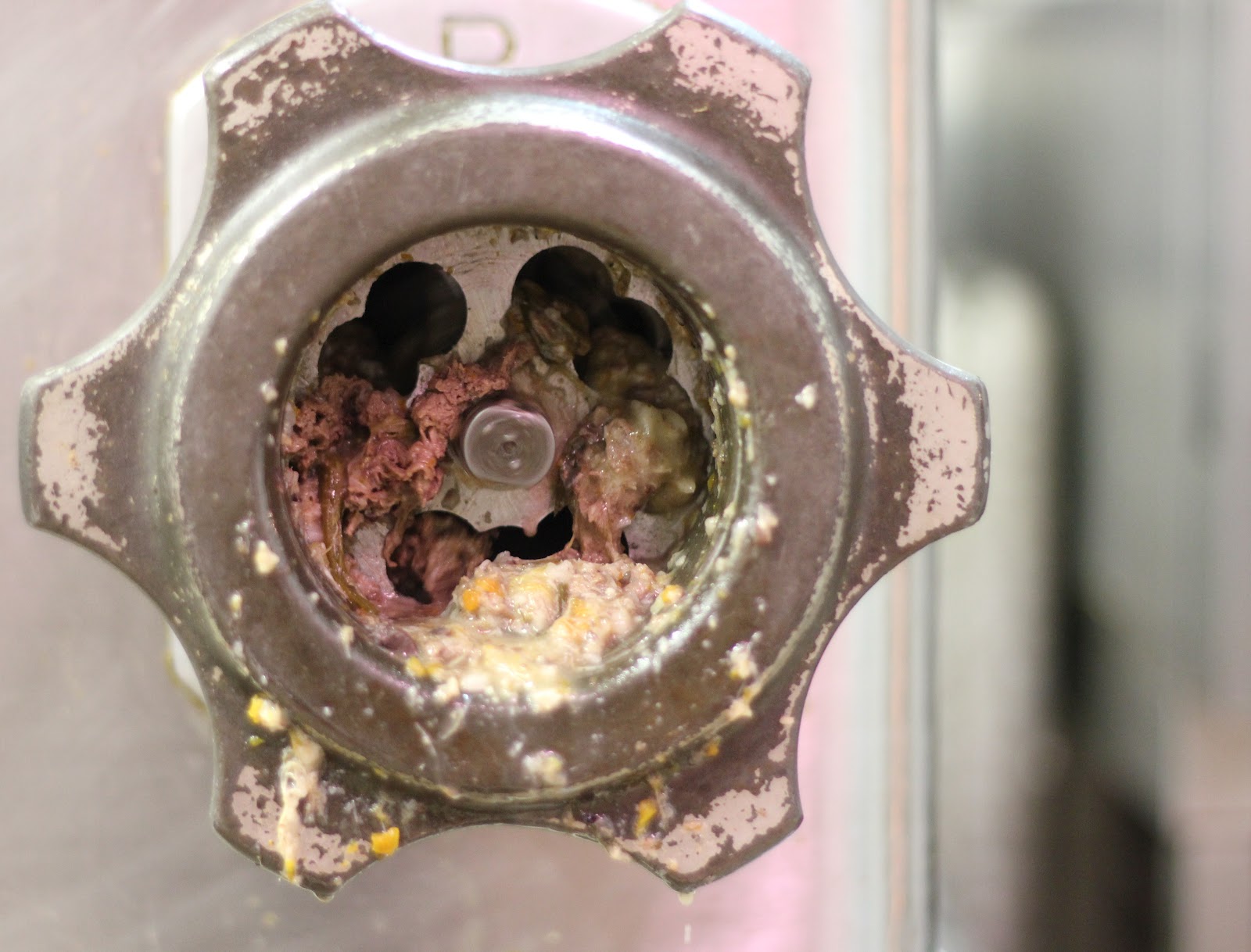
Every so often, on my trudge to work in the half light, I remember to look up. The looming panorama of Pyrenees never fails to give a little surge of pleasure which sits giddily with my early morning grumpiness. Sometimes I remember that I mustn’t miss the view of the Pic du Midi just around the corner only to forget by the time I get there – perhaps put off by a cunningly-placed poodle poo. Bof! Never mind. It’s Boudin Noir day today!

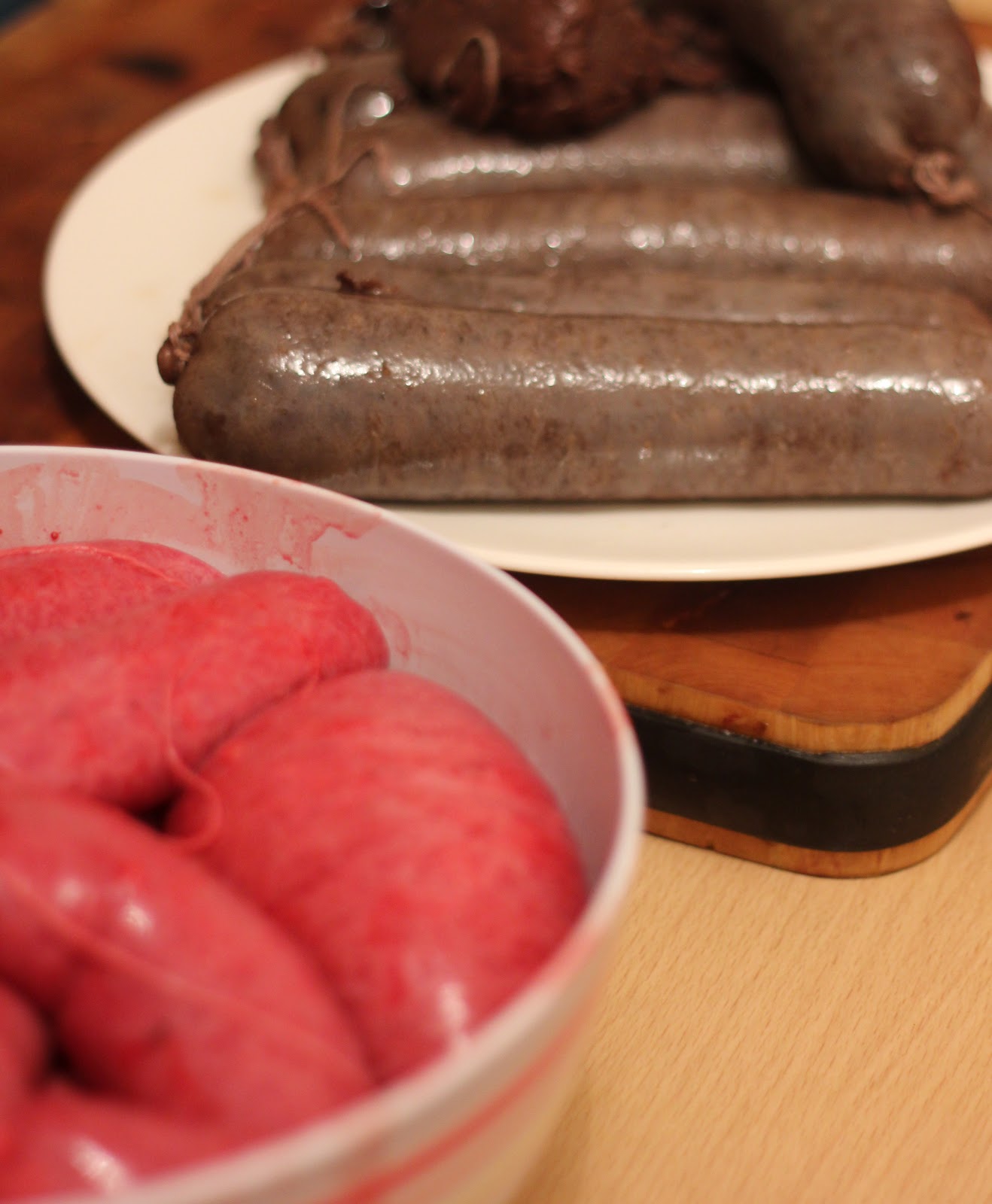
Making black pudding is brilliant. A gruesome, stinky celebration of the art, perfected over generations, of turning something unpleasant into pure gold. There are myriad variations of the blood sausage, and the version from the Béarn is a different beast to neat horseshoes of Bury breakfast pudding. Ours is bulging with meat and ugly as a badger’s bottom.

I’ve eaten lungs several times, a mistake, generally - with the obvious exception of the heroic haggis - but they go in our black pudding, along with hearts and some blubbery necks. No doubt, the splendid application which has been devoted over the years to finding good use for every last scrap of pig is scant consolation to the individual involved for a pneumatic bullet in the brain. However, I am heartened by such miserly wastelessness. The meat is perfumed and padded out with hearty proportions of stock veg and generous seasoning, and the lot is hubbled and bubbled for hours before being chopped and mixed with a gallon or three of blood.

“Delightful,” you might be thinking. And you’d be right. It’s beautiful. Even raw. I haven’t mentioned the stinky bit yet. A pig’s colon is about as unpromising as it gets. It smells really bad. It has a double skin, the interior of which has had a lifetime of odour-eating and so is beyond the pale, even for the French. This fatty, fetid stocking must be painstakingly separated from the useful and tasty outer layer, before the sausage making can begin. Frankly, even the cleaned boyaus have some odour issues, and they are often full of annoying holes, but for me they are indispensible to the glorious end product that is Boudin Noir Béarnais.


Even cleaning up is fun. Think of the waves of blood in The Shining and you’re not far off the mark. Not everyone’s cup of tea, perhaps – but I love it.

Monday, 16 April 2012

Steamed sponge pudding with my mum’s marmalade. And Custard!


I’ve finally got round to doing that sponge pudding with the marmalade I made in January. It turned out belter! Light, sticky, tangy and sweeeet.

I served it for a wine and food evening last week. The French guests apparently expressed concern that English patisserie wouldn’t be up to much. I won them over. It may not be common knowledge over here, but the British are very good at this kind of thing!

Steamed Marmalade sponge

8oz/225g butter, softened
6oz/175g sugar
2 lemon zest
1 orange zest
Seeds from a vanilla pod – if you have it. Don’t worry if not.
Fresh ginger, grated. The size of a fat man’s thumb. This is optional too (you can put in some all or none of the flavourings...)

4 eggs
8oz/225g Self-raising flour – or, if you live in france, 225g normal flour + ½ a packet of levure chimique (5g/1tsp baking powder)
A pincho salt
2 lemon juice

A big fat dollop of golden syrup
A big fat dollop of (ideally My Mum’s)Marmalade.


You will need a 2 pint pudding basin (or something which will approximate to one), and a pan or steamer with a lid, in which it will comfortably sit. And some foil (or baking parchment + muslin + string).


Before you forget, smear a bit of butter all over the inside of your pudding bowl, then tip in some flour and roll it around so as to entirely coat in a thin layer of white. Discard any excess. Spoon in a generous dollop of golden syrup and then the same of marmalade. Does it look like there will be plenty of syrupy lava splooging down the sides of the cake when it is cooked and unleashed? If not, add a bit more of both. Good work!


Now cream the butter, sugar and your chosen flavourings until white and fluffy. It’s important to get plenty of air in. And that your butter isn’t hard, or you’ll be there all day...

Mix in the eggs, one at a time.

Add sifted flour and salt. Mix gently until uniform.

Spoon on top of the syrup in your bowl. Try to ensure all the syrup is covered by the cake mix.

Butter the underside of a peice of foil and loosely cover the bowl. You can use a piece of greaseproof paper, buttered and with a pleat in, just hanging over the edge of the bowl. Next, a muslin covers that, also with a fold in it, which must be secured with string. This is the old fashioned way of doing things, but I’ve tried both, and the second method is just a lot more faff for no benefit at all...


Place in your steaming device for 1 ¼ - 1 ½ hours. Don’t let it boil dry! It’s cooked when it is springy to the touch, and a skewer inserted will come out clean.


Turn out while still hot and eat the glorious, steaming sponge, and it’s frankly dangerous molten lava topping, with a very generous puddle of custard. If you have the good fortune to be dining with abstemious types, eat theirs too!  


Proper Custard

This is a rich crème anglaise. If you’re feeling a bit more frugal, you could substitute the cream for more milk and perhaps change 4 of the egg yolks into a whole egg...

200ml/ pint Double cream (or milk, if frugal)
300ml/ ½ pint Milk (not skimmed! What’s the point in that?...)
A vanilla pod (use the one you scraped the seeds out of for the sponge – or a splash of vanilla extract)

5 egg yolks (or 1 if frugal)
1 whole egg (or 2 if frugal)
30g/1oz Sugar


Heat the milk and cream with the vanilla in a saucepan.

Rest a sieve on top of a bowl big enough to contain all the ingredients. Put it somewhere close to the stove. You will need it later.

When the milk is hot, reduce the heat and combine the sugar and eggs. Beat till light and a bit fluffy.

Pour half the hot liquid into the egg. Mix thoroughly. Don’t mess about – the eggs will cook in the milk so you need to be quick to avoid scrambling.

Pour your eggy mix into the remaining milk in the pan. Over a lowish heat whisk the custard diligently  till it starts to thicken. Make sure you scrape the whisk over every part of the pan bottom, especially the corners. You will start to see traces from the whisk in the thickening custard. Still whisking, remove from the heat and immediately pour through the sieve into your waiting cool bowl.

If, in spite of your best efforts, the custard has still split, fret not. Give it a good old blitz with a hand blender (the saviour of many a batch of crème brulée ) and it will come back, albeit a little less thick.

Serve hot and fresh-made or cold. Don’t try to reheat it, it will almost certainly split.


Sponge pudding and custard. If you don’t like this I pity you...

Monday, 9 April 2012

Lucky Peach


I’ve recently stumbled across toilet reading. I wasn’t morally opposed. It just seemed unnecessary: what could be more relaxing than having a good old poo? Why supersize the experience? (I have dabbled in privy guitar playing – because Jimmy Hendrix supposedly did. The acoustics are interesting, but it’s just a bit weird.) However, for my birthday, Dot bought me a copy of a new food quarterly from America, Lucky Peach.

I’ve never had much time for magazines: short attention-span reading, lots of not-very-interesting stuff (much like The Internet) that I can’t be bothered wading through in order to happen on something good. Food magazines are inevitably geeky, and largely boring. I like Nigel Slater in the Observer magazine but can’t be arsed with OFM – too much of an ok thing. But I’m really enjoying Lucky Peach. It’s a vehicle of Dave Chang, New York noodle bar chef/tycoon – I’d never heard of him or his Momofuku restaurants, but then I’m staggeringly ignorant about lots of things.  Initially I found it overbearing, in both its Anthony Bourdain-style, American gung-ho-ness and its veneration of famous chefs. Yes, it is geeky, but it’s rather snazzily well-written. There aren’t too many recipes, and there’s a story to them (which I like) and it’s funny, interesting… and annoyingly out of my league. I wouldn’t recommend reading it cover to cover, but it’s perfect to dip into in bite-sized portions… Don’t forget to wash your hands!

I particularly enjoyed the idea of a booze-addled crab-boil feast – newspaper tablecloth, gas station beer, and sweet crab sap dribbling down your chin! It’s on my to-do list; I’ll keep you posted...


Wednesday, 21 March 2012

Mullet


I went fishing again on Monday; a pastime that has the ability to make me feel uniquely foolish. In spite of this – or maybe even because of it – I came home with a couple of beauties!

The grey mullet looks like a softy. Seaweed eating, with big rubbery lips, and the nice but dim expression of a clodhopping puppy, it’s difficult to imagine a more benign fish. They are beautifully striped along the length of the body, and look a bit like a divvy version of the American striped bass.

Here in France they have a reputation for being terrible to eat, as they are the fish one sees mooching around the port eating chips and sewage pipe sea lettuce. Fair enough, I don’t think I’d eat one of them either, but my fish were caught, with a bit of bread on a hook, on an inlet, just 100 yards from the open sea. The first was beautiful, with a flavour and texture very similar to bass. Raw, I could taste the seaweed diet, but once cooked it was delicate, with deep white flesh, and really superb. We’ll have the other one tonight! Yum! It will be interesting to see if there is a disintegration in quality of the flavour between the first, eaten before rigor mortis even had chance to set in, and the second, eaten 2 days later, after the rigour has waned (I hope. As I write it’s still stiff – is that bad?). It’s still spanking fresh by the standards of shop-bought fish. I’m sure fish mongers often deliberately store fish before sale. Is this because they develop flavour, like beef? I’m afraid it’s a bit of a mystery to me...

Of course I didn’t actually catch them. Have you not been paying attention? I stood by the water, not knowing what I was doing, doubtless with a particularly amusing choice of bait for the situation. A man who’d been set up nearby came over and offered me a share of his catch – his wife would moan if he came back with too much! Haha! What a nice man. (He must have had his eye on me. Did he take pity because I looked like a tool?) I sheepishly but gratefully accepted. He told me about the bread as bait, and that the mullet puts up a spiffing fight, making the fishing a crack-a-laugh! Combined with their dim-witted appearance, this made me feel a bit sad to be bopping it on the head, slicing through its gills to drain the blood before taking it home in a carrier bag. Not sad enough to not do it, I might add, but still...


I can't not make cevice when I get a bit of fish as fresh as this - lemon, cumin, garlic, chillies, shallots and corriander. I've not tried it with grey mullet before: it worked a treat!


Main course was the thick end of the fillet fried in some bacon fat and served with some simple greens. Briefly boiled brouttes*, dressed with some warm olive oil and softened garlic. Clean and tasty - a top way to welcome the beginnings of spring. 


Two days later: no noticeable deterioration in flavour.

Dot said she fancied ginger. It turns out a ginger mullet can be a winner! A few slivers of chilli, garlic and shallots to acompany the ginger, sandwiched between the fish, which was steamed for maybe five minutes. Plonked on top of some moroccan-style chick peas with olive oil and cumin. We had a little sweet and sour dressing made from white vinegar, sweet soy, a drop of nam pla (fish sauce), a scattering of the aromatics that stuffed the mullet, plus some herbs for freshness - mint, basil and corriander.

All of these dishes would be great with bass, but honestly I thought mullet was at least as good.

I might go fishing more often!!


* Young shoots of cabbage. They are pleasantly similar to purple sprouting brocolli. Yum!


Friday, 16 March 2012

Donostia. A Fiesta of Pescado


A foodist holiday in North-West Spain is a mixed bag. Ours steered clear of the posh places, which, I expect, run the full spectrum from simply wonderful to should-have-been-a-lot-more-bloody-wonderful. One day we’ll go to a crazy, fancy, Basque food-cathedral gaff, but it’s not really what excites me: I’m too stingy. On other trips we’ve been initially wowed, only to be largely let down. Spanish food’s supposed to be cool and interesting isn’t it? The ham is amazing, even the cheap stuff’s really good. Tortilla, the heroic spuddy omelette-cum national crutch, is probably my all time bestestever sandwich filling (especially with a bit of jamón on the side) – but I had to come to Spain to realise it could also be shite. Bocadillo de lomo*! Om nom nom!!! Maybe that’s my favourite... Salt cod is great, hake is great. Any of these things done well, on their own or combined, will make my day. But not every day. Why is it so hard to find vegetables? Pimientos de padron doesn’t redress the balance – fried mini green peppers are tasty, with a little crunch from rock salt sprinkled on top. All good stuff, but where’s the salad, hombre? I want a radish. I’m pining for broccoli, for fuck’s sake...**

With this in mind we booked self-catering in San Sebastián. We would still eat pintxos (the Basque tapas, pronounced ‘pinchos’) and drink beer and have fun, but when we got back to base we could have some carrots.

The pintxo bars were what brought us here. Last year we’d spent the afternoon, and had to drive home after only two little beers and a fantastic plate of pulpo gallega (octopus with olive oil and paprika). The temptation was to stay and drink and eat – and walk back to France... Instead we promised to return. 

The Basques call it Donostia (which, surprisingly, also translates as Saint Sebastian). It’s rather a grand, sophisticated place with an old town, a new town and three spectacular beaches, but also a vague scruffiness that we are always struck by when entering Spain from France†. I quite like a bit of scruff, mind you. We headed straight out to the old town to fill ourselves with ham, eggs, spuds, salt cod, grease, bread and beer!

A good night. I wanted to check out the fish market so at the end of a very lazy morning we bimbled into the Bretxa food hall. It was still very busy and the fish stalls were predictably great. There were exclusively whole fish on display. They were prepared to order by fishmongers wielding big curvy cutlass-type knives. I surprised myself by recognising most of the fish: bass, bream, maigre, pollack, cod, herring, mackerel, monkfish, dover sole, lemon sole, brown gurnard and, my favourite, weever. And hake, hake, hake. They were all buying hake.

All the stalls were exceptional (and dirt cheap) by my standards, but the one that held my attention was like an art installation‡‡. It didn’t have the most spectacular display, there was no snaking queue – the fish looked top notch and it was displayed simply and prettily, but the guy at work behind the counter was mesmeric. I must have peered at the gliding and flicking of his knife for half an hour before I realised I ought to have taken a ticket to be in the queue.  I took one and continued to stare, transfixed. He was a magician: relaxed, unhurried, deliberate, smooth, delicate but effortless. While I watched he must have prepared five hake in exactly the same way, all perfectly portioned and placed ready to be wrapped up for his discerning customers. He was very cool. I think he’s my new hero... When my turn came I hadn’t even decided what to buy. I got what the man before me got (to go with his hake). I thought it was a fresh herring. I’ve only just found out it wasn’t. I also bought raw prawns and a few fancy-looking clams. ¡Gracias señor! Brilliant! Grab some incredibly lovely ham and salchichon, don’t forget the veg, find Dot (by now, almost suicidal), and off home for a luncheon feast! Via a swift cerveza of course!
Scad, or horse mackerel (with broccoli!). Weever cevice. Yum and Yum!


Hake 'bianco', with paprika - so 'rojo'

Merluza con salsa verde - hake in parsley sauce.


*Thin boneless pork loin chops slapped in the middle of a baguette. I don’t particularly like the red stuff that has been marinated in paprika and garlic. Fresh and plain is where it’s at – grilled with plenty of salt and perhaps a squeeze of lemon. Don’t overcook it and let it rest in the bread so that you keep all the juices! Om nom nom indeed!  God, i’m starving...


** Broccoli’s for girls. Not purple sprouting – that’s for winners and kings!


Check out the link for a very informative and useful list of pintxo place recommendations. Don’t be a slave to recommendations, though. Follow your nose and try lots of places. You don’t have to stay if it’s not up to much... You might end up getting a little drunk, mind.


† The cake shops are an interesting example of this. Go to a patisserie in France and then into one in Spain. You’ll see what I mean.


However, a bit of internet research, and the herring that I bought turns into a ‘horse mackerel’, or scad. Oh well. Serves me right for allowing myself to feel clever...

‡‡ Not in the boring and pointless sense. Although, perhaps Dot wouldn’t agree...   

Friday, 2 March 2012

A bit nipsville


We’ve had a fortnight of serious cold, which as I sit down to write about warming food, appears to have abruptly ended. The beautifully odd frozen fountain on the 18th century square where we live has melted without me having got round to taking a photo. It grew, splash by splash, as the cold days passed, to a spectacle of ogreish deformity. It was a sight to see... Sorry.

Red cabbage has helped keep us warm. Always cheeringly colourful, it can do sharp, spicy and crisp as a counterpoint to a calm, warming stew; or still spicy but less sour, sweet with apples and a tickle of muscovado – warming on its own, but at its best with the magnificence that is a confit duck leg; or enriched with duck fat and onions, and simmered with wine or beer. Served in a great steaming mound with smoked sausage, spuds and bacon, all cooked in the same pot. A dish to warm like a bonfire on even the most nippy of nights.

The latter is a choucroute for people who don’t like choucroute or sauerkraut, as the germans call it. It is my way of not needing to buy the perfectly white, fermented cabbage from Alsace, which is a strange taste I’ve only recently, gradually, acquired. I served it with some great cheap bits of confit duck at my last cave soirée. Still flavoured with juniper and cloves, it is sweet where the proper choucroute is sour. And, whereas the cooking liquor is traditionally strained off, I like mine, so I include it as a thin but rich and tasty gravy. It's almost garbure, the  thick stew/soup from the Bearn region, made from duck and cabbage. Whatever you call it, it'll warm the cockles of your heart!

Red Choucroute

½ to 1 whole red cabbage, depending on the size and how many you want to feed), thinly shredded
3 or 5 onions

A couple of cloves of garlic

An extremely large dollop of duck fat
1 bottle of cheap, very dry white wine. Or continental-type lager, 750ml.

Some kind of stock, homemade is best, obviously, but a cube will do. Failing that, a bit of water.
A teaspoon of juniper berries, crushed up

A couple of whole cloves
A tablespoon of coriander seeds (if you have them – you can do without)

A bay leaf
Salt and pepper

A firm-fleshed potato per person
3 or 4 carrots

Some or all of the following including at least one smokey thing:

A chunk of smoked or unsmoked pork belly (streaky bacon)

Smoked sausages

A ham hock (simmered separately for an hour or so – in water with a bay leaf, onion, carrot, peppercorns, a few fennel seeds and a bit of garlic. This will make great stock. You can use some of it below, and make soup from the rest)

Confit duck (I use wings and neck -cheap-, but leg is great, gizzards wouldn’t go amiss...)


Just make sure there is enough meat for everyone to have some of everything. Bearing in mind that this is a meal for greedy people.


The long bit is shredding the cabbage. Try to slice as thin as you can, but don’t chop your fingers off... It’s a good exercise in knife skills, actually. If you’re including the ham hock, get it cooking before you attack the cabbage.  Slice the onions similarly, chop up the garlic a bit and gently fry these two in a large, deep pan (with a lid) in much more duck fat than you think is necessary.

When the onions have softened, add the juniper, bay leaf, cloves, coriander and lots of pepper. Give a stir and add the red cabbage. Mix it all thoroughly so that the duck fat has coated all the cabbage. Turn the heat up. Try the wine/beer. If it’s nasty put it all in the pot. If it’s drinkable pour yourself a glass, the cabbage will have to cope with what’s left.

Add stock to nearly cover the cabbage. Nestle in your bacon and ham hock if you are having one, add a little bit of salt if you’re not. Cover with a snug lid, bring to a simmer, lower the heat and cook, ploof... piffle... plip, for half an hour.

Take off the lid and have a nose. Make sure there is still some liquid. Push your remaining meat into the cabbage. Lie spuds on top of the lot, to cook in the steam. Replace the lid and simmer for another hour or so, adding the carrots on top of the potatoes with half an hour to go.

Open up the pot and have a taste. Is it salty enough? The juices should be sweet, spicy and delicious. The cabbage still a deep purple. Remove all the meat and veg to one side. Pile the cabbage onto a giant serving dish, add a bit of the gravy and arrange the garnish on top. Bring to the table still steaming hot and munch, slurp and sloop with plenty of crusty bread and prodigious quantities of wine*.


*Interestingly, both red and white are good. For our wine and food evening we had:
Rully 1er cru La Pucelle 2009 Domaine Jacqueson (white Bourgogne)
Trousseau Grands Vergers 2009 Domaine Gahier (Red Jura).
Faugères Tradition 2010 Domaine Binet Jacquet (Red Languedoc),
The Borgogne won for me, hands down, bringing out the corriander and complimenting the sweetness of the duck and cabbage brilliantly. The reds were quite different, the Languedoc rich and round, with a bit of spice, which complimented the meat and the smokey flavours nicely, whereas the Jura was in direct contrast to the sweetness of the dish, supplying a sharp side to cut through all the richness, and, let’s face it, fat... Anyway, plenty of good choices on the booze front!!